
Composite vs. pressure-treated decking is the decision that shapes everything else about your deck project — the budget, the maintenance schedule, and how the deck looks in year ten. There's no universal right answer, but there is a right answer for your yard, your budget, and how long you plan to stay in your home. Here's how the two materials actually stack up in Edmonton.
Composite vs. Pressure-Treated Decking at a Glance
| Factor | Pressure-Treated | Composite |
|---|---|---|
| Upfront cost (installed) | $ | $$–$$$ |
| Maintenance | Stain/seal every 2–3 years | Soap-and-water wash |
| Lifespan | 15–25 years with upkeep | 25+ years |
| Warranty | Treatment warranty only | 25–50 year manufacturer |
| Look over time | Greys and checks without stain | Holds colour, no splinters |
| Winter performance | Good — can crack/check | Excellent — no rot, minor expansion and contraction |
The Case for Pressure-Treated Decking
It's the most deck for your dollar, plain and simple. Pressure-treated (PT) lumber is pine infused with preservatives that resist rot and insects. In Edmonton, a PT deck typically comes in at roughly half the price of the same deck in composite. If you're working with a firm budget and want the biggest usable deck you can get, PT wins.
It also handles Alberta's freeze-thaw cycle well — when it's built right. Proper joist spacing, gapped boards, and good drainage matter more to a PT deck's lifespan than the material itself. The trade-off is maintenance: plan on cleaning and re-staining every 2–3 years. Skip that, and the boards grey out, check, and start splintering. A neglected PT deck at year 12 looks rough. A maintained one at year 20 still looks solid.
PT is right for you if:
- Budget is the deciding factor
- You don't mind (or actually like) staining every couple of summers
- You may sell the home within 5–10 years
- You want maximum square footage for the dollar
The Case for Composite Decking
This is the premium build, and it looks like one. A Corolla and a Porsche both get you to work — but nobody buys a Porsche for the commute. Composite is the same idea. Brands like Fiberon and Trex come in rich colour lines, realistic grain patterns, and fully matched railing systems, so you can spec a deck that looks exactly the way you pictured it — and it holds that look for decades instead of fading toward grey. When you want the highest-quality material on the market and a backyard that shows it, this is the lane.
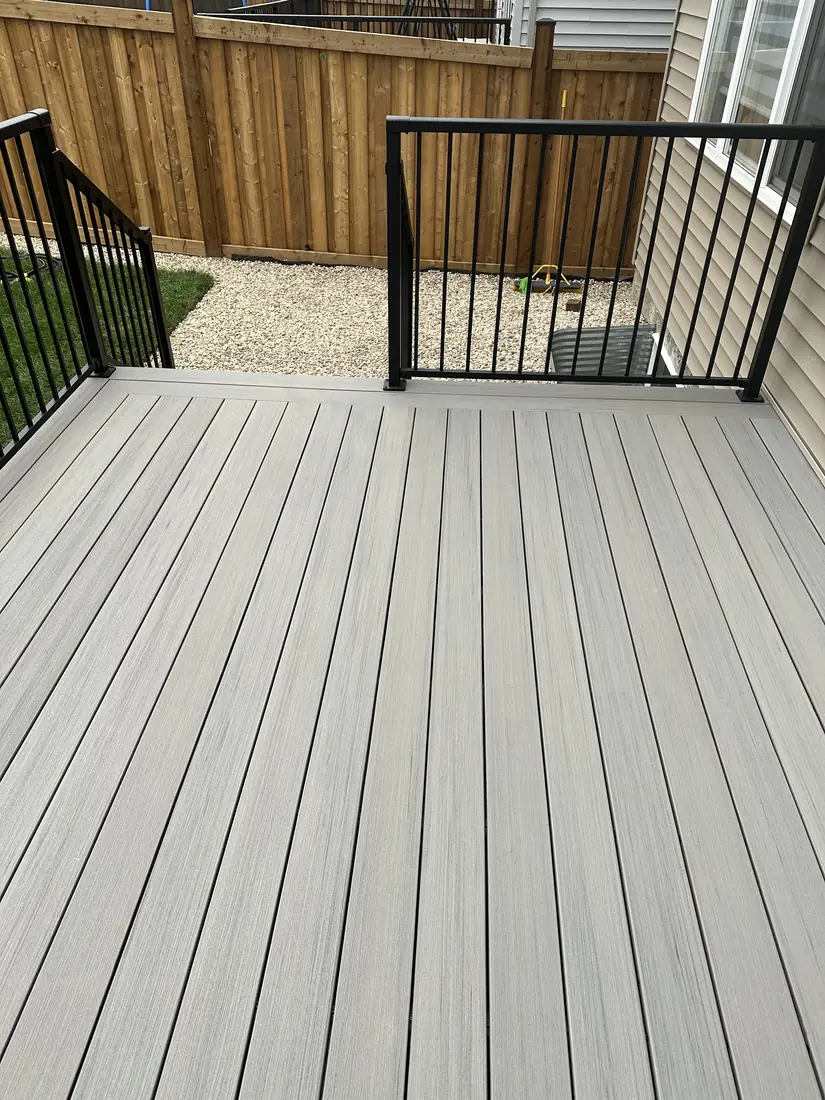
The practical case backs up the looks. Composite boards are wood fibre and plastic capped with a durable polymer shell: no staining, no sealing, no splinters, no rot. Maintenance is a hose and a brush once or twice a year — composite is low maintenance, not no maintenance. Manufacturers actually require periodic cleaning to keep the warranty valid, and shaded Edmonton decks can grow mildew in the board gaps if they're never washed. It's a small job, but it's real — which is why every TrueBlue build includes a free 1-year checkup. The upfront cost is real — roughly double PT installed — but a PT deck needs 5–7 rounds of stain over 15 years plus board replacements, while composite needs none of that. And the 25–50 year manufacturer warranties are transferable on most product lines — a legitimate selling feature if you list the house.
One thing to know: composite expands and contracts with temperature swings more than wood does. That's a non-issue when the installer gaps the boards to the manufacturer's spec for our temperature range. It becomes a problem when a builder installs it like wood. Ask any deck builder you're quoting how they handle composite gapping in a climate that swings from -35°C to +30°C.
Composite is right for you if:
- You want a high-end look — specific colours, grain, and matched railing
- You're staying in the home long-term and want next-to-no upkeep — a wash or two a year, no staining, ever
- You care about how the deck looks in year 10, not just year 1
- Barefoot-friendly, splinter-free boards matter (kids, dogs)
What About Resale Value?
Both materials return well at resale in Edmonton — a deck is one of the better-returning exterior projects, period. Composite tends to show better at listing time simply because it doesn't depend on whether the previous owner kept up with staining. A five-year-old composite deck looks nearly new; a five-year-old PT deck looks exactly as good as its maintenance history.
The Bottom Line
If budget rules, build pressure-treated and commit to the staining schedule. If you're in your forever home and never want to hold a stain brush, composite pays for itself in time and warranty. And if you want the middle path, the PT frame + composite surface hybrid gives you most of the benefit at a fraction of the premium.
Not sure which way to go? Use the 3-Minute Deck Estimate — build your deck once, then flip between pressure-treated and composite and watch the price change live. Compare real numbers, not guesses.
Compare Both Materials on Your Actual Deck
Design your deck and price it live in 3 minutes — then flip the material and compare PT vs composite live.
Get My 3-Minute Estimate →